This engagement was somewhat of a surprise for all involved. Arab slavers from the Northwest Pafrasian coast along with local Rugaruga mercenaries were attempting to raid a Dabolu village in the North of Daboluland. The situation was complicated by the fact that due to their disdain for the natives, the Arabs made no efforts to conceal their plan of attack. This was to have unfortunate consequences, as the local French military governor learned of the Arab's approach, and assembled a column to intercept them. Here then is a faithful account of the action the ensued.
Emir Asad Thuayba Ali had ordered his servant Karim Raisul al Faiyiz to assemble a force of brave warriors to serve Allah by taking the sword to the infidels of western Pafrasia. Al Faiyiz immediately assembled 32 of his faithful retainers, as well as sending word to the fierce mountain Fuzwa tribe. 20 warriors joined him, armed with their traditional broadswords. Additionally, al Faiyiz hired 60 of the local toughs, or Rugaruga, who joined the assembly with an motley assortment of firearms. This column set sail aboard six dhows, and landed just north of the northern most extent of Daboluland. After encamping along the coast on the evening of the 25th, al Faiyiz ordered an advance upon the nearest Dabolu village on the morning of the 26th.
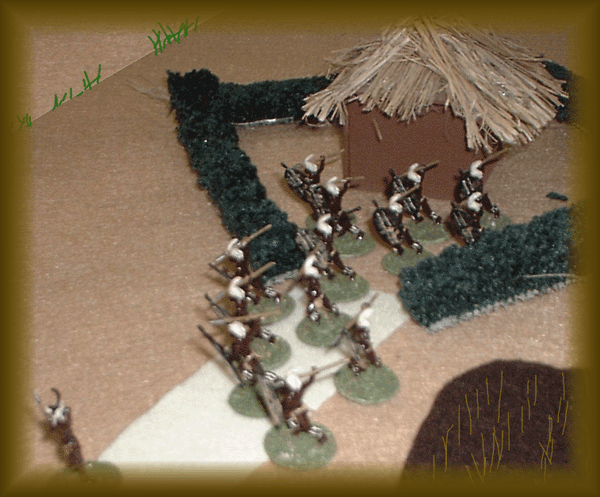
Meanwhile, the local Dabolu kibwana, Msobolo, had received word of a mighty host massing against the Dabolu. Sending the woman and children south, towards central Daboluland, Msobolo sent word to the villages under his rule, ordering the warriors to assemble. They took up positions amongst the brush and scrub that lined the ridge which lay northwest of the village. There, they waited, intent on saving the village from any threat.
 Msobolo was not the only one who had received word of the Arab approach. The military governor of Amitie, General Fortune Girard, had recently ordered his lieutenant in northern Daboluland, Captain Jerome Boulaide to "deal" with the continued problem of slavers plying the Pafrasian coast. As luck would have it, a native runner came into Boulaide's outpost late on the evening of the 25th, informing him of a vast number of Arab slavers encamped on the northern border of Daboluland. Hoping to surprise the slavers, Boulaide gave the order to strike camp, and he marched north with a platoon of Infanterie de Marine, another of Tiralleurs Pafrasian, and a naval crew with 'mitrailleuse'.
The morning of the 26th saw continued preparations on Mbolu ridge. Msobolo had his men hidden in scrub areas on either side of the lowland that led to the village. Three bands of 20 men were located in the scrub terrain lining the slope leading up to the ridge, while 20 men waited in a swampy lowland opposite them. Another group waited on the ridge itself, and a last group hid in the tall grass south of the village. The natives had no firearms, but were adept at using their spears for either thrusting or throwing. The Dabolu as a rule were not as well organized as their Kezande or Umbulu neighbors to the south, but they were motivated by a desire to protect their homes and cattle.
It was 0800 hours, and the sun was beginning to really heat up the Pafraisian plain as al Faiyiz's column came into view of Mbolu ridge. At the head of the column was a band of rugaruga, followed by the Fuzwa swordsmen. The remainder of the rugaruga came next, with the Arab rifles and mounted troops bringing up the rear. Oblivious to the preparations being made for their arrival, the column marched onward, with nary a man being dispatched to scout. Drawing close to the brush which (unbeknownst to them) held scads of Dabolu spearmen, the lead group of rugaruga deployed into a loose line in preparation for an attack on the village.
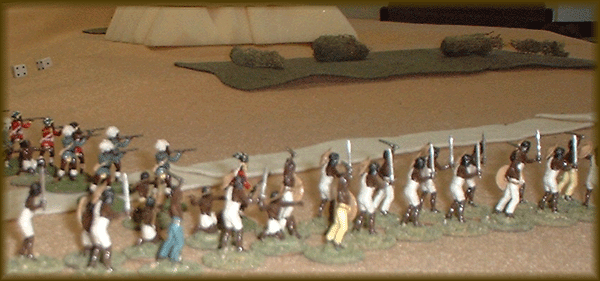
At this point, the situation grew slightly less clear. A platoon of the Tiralleurs Pafrasian emerged from the tall grass to the south east of the advancing Arab column. One of the brighter bandits noticed the appearance of what seemed to be a formed body of troops, and decided that it would be a good time to go to the back of the column to 'inform the leader'.
The Dabolu also noticed the approaching French troops, but Msobolo, correctly judging that nothing would be gained from a rash redeployment which would expose their positions. Through earnest whispers, he exhorted the warriors to remain prone in cover. For the most part, the troops heeded his command, but the warriors who had been deployed in reserve on the ridge proper we shaken into movement. They began to rush towards the northern side of the Arab column. Seeing this threat some distance off, al Faiyiz ordered a group of rugaruga northwards, intending to keep the natives pinned down under musket fire.
 At this moment, all hell broke loose at the foot of the ridge. The group of Dabolu spearmen who had been crouched down in the swampy area, rose up, and with a collective shout, rushed forward into the ranks of the approaching Fuzwa swordsmen. A moment latter, a cry rose from the brush on the slope of the ridge, as another mass of spearmen leapt forward and crashed into the flank of the advancing rugaruga. Only a few of these mercenaries were able to fire hasty shots off, before throwing spears brought two of their number down. A moment later, the Dabolu were in their midst, and a confused melee developed. Meanwhile, the Fuzwa reacted to the native attack by drawing their swords and stepping up to meet their attackers. A confused combat thus engulfed the entire head of the Arab column, and the troops to the rear began a hasty deployment, preparing to receive any further attacks.
The Fuzwa swordsmen fought bravely as individuals, but their formation was compromised by the sudden Dabolu rush, and after several Dabolu were cleaved in two by the more zealous Fuzwa, the formation fell back in disarray, leaving several of their number behind as casualties. Meanwhile, the rugaruga to the north were putting up surprisingly stiff resistance. For a moment, it looked as if the Dabolu were going to be pushed back, until their leader stepped forward, and personally slew three of the mercenaries and put the rest to flight.
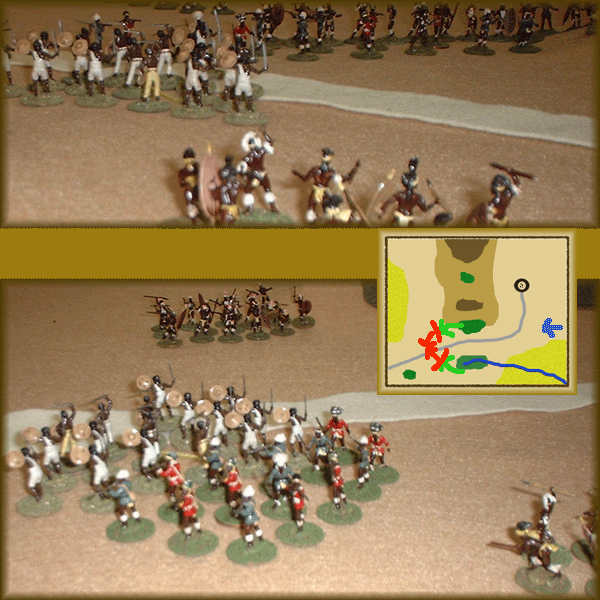
 With their audacious charge, the Dabolu had caused the discomfiture of the entire head of the Arab column. Al Faiyiz, displeased by this setback, ordered his own Arab retainers into a skirmish line facing to the north-east, and then rode forward to attempt to rally the retreating troops. The Fuzwa reformed, with the Arab cavalry/camelry to their rear, while the rugaruga continued to withdraw towards the rough group. By this point al Faiyiz's troops were deployed in a roughly semi-circular shape, advancing north and east.
Mfufei, seizing the opportunity presented by the collapse of the front of the enslavers column, led his surviving followers towards the flank of the northern most group of rugaruga. As they dashed across the open ground, they were subject to a hot fire from the European breech-loaders of al Faiyiz's retainers. Mfufei himself was struck by several bullets, but even as he fell, the spearmen following him crashed into the open flank of the rugaruga, putting them to flight. So terrified were the mercenaries that they didn't stop running until they reached the coast.
Captain Boulaide was rather unnerved by the sudden sound of gunfire to the front of his column. Jogging forward to gain a better vantage point, he saw what looked like Dabolu warriors engaged with some other force up ahead. With an arrogance typical of Europeans in Pafrasia, Boulaide ignored the possibility that the Dabolu would be any threat to his column, and ordered the march to proceed, directly towards the sound of gunfire.
Msobolo had in turn noticed the approaching Europeans with some dismay. Although the Dabolu had coexisted with the French costal garrisons for sometime, he wasn't convinced that they were merely on a journey of exploration. Still, Msobolo deemed the slavers the larger threat, and thus sent runners out, informing his sub commanders not to attack the Europeans unless fired upon.
This order did nothing to restrain his warriors from rushing into the attack. Another group of warriors emerged from cover and tried to close with the new line of advancing rugaruga. This time however, they did not have the benefit of surprise, and a hot fire from the mercenary musketeers forced them to go to ground. Simultaneously, the survivors of Mfufei's group began to fall back under a heavy fire from al Faiyiz's retainers. Mfufei himself was dragged back by two of his comrades.
As the majority of the visible Dabolu troops were now pinned down or withdrawing, al Faiyiz ordered a general advance, intent on using his superior firepower to complete the rout of the Dabolu forces. He noticed the approach of disciplined troops in the distance, but dismissed the possibility that they posed a threat to his goals.
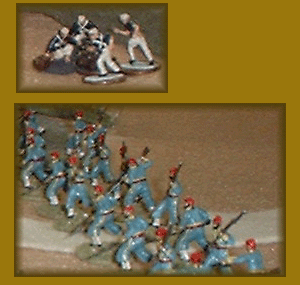 Captain Boulaide, meanwhile, also glimpsed the now distinct Arab troops. Thanking the gods of war, for the fortune of running into his intended target, Boulaide ordered the Tiralleurs to deploy in open order firing line, while the mitrailleuse team assembled their weapon to their right. He personally led the Infanterie de Marine towards the slope of Mbolu ridge, intent on occupying the high ground.
As the Dabolu troops remained motionless along the front, the French machine gun opened up on the advancing rugaruga, it's harsh staccato joined by an arrhythmic popping of rifle fire, as the Tiralleurs were ordered to fire at will. Those rugaruga who were not dropped by this fire immediately, went to ground, struggling to find any cover that they could.
Taking stock of this new threat, al Faiyiz judged that aggressive action was necessary. He personally led the Arab mounted troops at the gallop towards the open order line of tiralleurs. "For Allah!" he shouted, as the ululating of his men became louder than the French rifle fire. Unfortunately, the strongest vocal cords in the world could not stop the French bullets, and man and horse alike were shredded by a murderous fire from the Tiralleurs and the supporting mitrailleuse. Al Faiyiz himself was unhorsed, and then, struggling to free himself from his stirrups, was struck half a dozen times, before he gave up his spirit murmuring a Koranic verse. The two men who were not struck by enemy fire, seeing the death of their leader, turned their mounts around, and tried to extricate themselves from the field of death they had entered. The charge was unsuccessful.

The charge did give the rugaruga a brief reprieve however, and they began to lay down as much fire as they could on the French positions, especially concentrating on the machinegun crew. The lieutenant commanding the gun, as well as one of the enlisted men were brought down by this sniping, temporarily taking the machinegun out of action as the surviving crewman tended to their commander's wounds.
Unaware of their commander's death, Arab and rugaruga troops began to advance up the southern slop of Mbolu ridge, intent on flanking the advancing French forces. It seemed as if Dabolu resistance had ended, and that victory would be achieved if the outnumbered French could be put to flight.

The fight hadn't yet left the Dabolu however, as Msobolo himself led more men out of cover on the south slope, and into the guns of the advancing slavers. Simultaneously, more Dabolu rushed out of the tall grass to the south, and attacked the right flank of the Arab line. In the north, where Msobolo was leading, the fire from the Arab line forced the men to ground before they were able to leave the cover of the scrub bushes. In the south however, despite heavy losses on the approach, the Dabolu closed with the rugaruga there, and caused heavy losses with their throwing spears. This frenzied attack forced the rugaruga to withdraw opening the entire right flank of the enslavers' line.

By this point, the entire French line was organized and pouring a tremendous volume of fire at the Arabs and their mercenary cohorts. Besides this, news of al Fayiz's death was spreading amongst the ranks. The Arabs themselves were willing enough to proceed with the attack, but the rugaruga, always eager for loot, but not for death, began one by one to make a strategic redeployment towards the rear. Not knowing for certain his commander's fate, but unwilling to proceed without the support of the mercenaries, al Faiyiz's lieutenant ordered a general withdraw of the entire force. The Dabolu were too exhausted to mount any sort of pursuit, while Captain Boulaide, uncertain of what other enemy troops might be present, gave the order to cease fire and dress the lines.
The Arabs were able to withdraw from the field in good order, taking only a few wounded Dabolu with them as prisoners. The Dabolu were able to return to their villages, while Captain Boulaide and his party spent the evening encamped near the village, before returning to their costal stockade the next day.
The game itself was a tactical victory for the Dabolu/French side. The French lost only three casualties the entire game, but they failed to annihilate the enslavers, which would have been the ideal result. Still, the Arab emirs will have to think twice before sending troops into Daboluland from now on. The Dabolu celebrate their victory, unaware that the help rendered to them by the French will eventually come back to haunt them in the form of greater French presence in the region.
As a final note, Mfufei, the heroic leader of the initial Dabolu attack, was able to recover from his wounds, and was granted several dozen head of cattle by the Dabolu king.
Appendices:
Pafrasia
Pafrasia is an imaginary continent located in the Indian Ocean which myself and fellow gamers have invented. It is inhabited by various groups bearing resemblance to the tribal people of Africa, South Asia, and the Pacific Rim, alongside outposts of European imperialism. Historically, European powers never fought one another over colonial possessions in Africa or Asia. Such diplomatic niceties do not exist in Pafrasia, and hence, it gives us an excuse to have the white men fight it out from time to time.
Dabolu
The Dabolu are one of the fictional tribes on the fictional continent. Their fictional society is nearly identical to that of the Zulu people of South Africa c.1870. Their economy is based on raising cattle. Their government is a feudal monarchy. Their military is based on age linked conscription.
Tiralleurs Pafrasian
These fellows are based on the historical 'Tiralleurs Algeriens', who were North Africans who fought for the French after the occupation in the 1830s. Their uniform is in fact the same.
Fuzwa Tribe
Based on the historical Haddendowa tribe of the Sudan. Historically these fellows raised their traditional broadswords against the British and Egyptians in the 1880s under the Mahdi, during a popular Muslim insurrection. In Pafrasia they often help their fellow Muslims, the Arabs.
The Game
The game was conducted using a rule set entitled "The Sword and the Flame". If you've ever played W40K, you will have some idea of the basic game mechanics. Basically, movement, ranged combat, close combat, and morale are all accounted for by rules. The rules, plus random chance provided by a deck of cards, and 6 and 20 sided dice determine the results of actions which the players undertake.
The Players:
 frosty_tsm: Played the role of al Faiyiz, the Arab commander in chief. Previous experience in CS and SPWAW. Had played in a few miniatures games before this game. Made the mistake of not scouting out the rough terrain before deploying his troops.
 theiceman: Played the role of al Faiyiz's unnamed lieutenant. Came in with a little SC experience, and not much else. Commanded the rugaruga competently, but was plagued by some bad card draws.
 grim: Played the role of Captain Boulaide. Lots of CS experience. Led the French to a tactical victory, by making maximum use of their firepower. Also terrified the Dabolu commanders, by not letting them no which side he was on until the last moment.
 alferdpacker: Played the role of Msobolo, the Dabolu commander. Heavy SC experience, and some experience with miniatures. Made good use of terrain, and skillful timing to orchestrate the Arab defeat.
 Loae666:Played the role of Mfufei, the Dabolu sub commander. Came in with some SC experience. Masterminded the initial Dabolu charges which led to the rout of three Arab units at the beginning of the combat.
 funnymarx: Played the role of god. Lots of experience losing in SC. Has been miniature wargaming since before he had a PC. All the miniatures depicted in this battlereport were painted by him.
If you guessed that this whole battlereport is in fact merely a vehicle to get lots of people to admire my flawless painting technique, then you get a gold star. :)
Credits: Thanks to all the players. Thanks also to all the people who stopped by to stare in amazement at the beautiful miniatures. Thank you to Esci and HaT for their beautiful figures. Thanks is also due to the Major General. If you're interest has been sparked by this battlereport, make certain to go visit his site.
Well folks, that's the end of the battlereport. I'd ask you all to stick around, but I have to spend the next hour poking myself with a sharp stick. Please come again.
This has been a Viaduct production. 
--funnymarx
 Home
Forum
Starcraft Tournaments
Home
Forum
Starcraft Tournaments