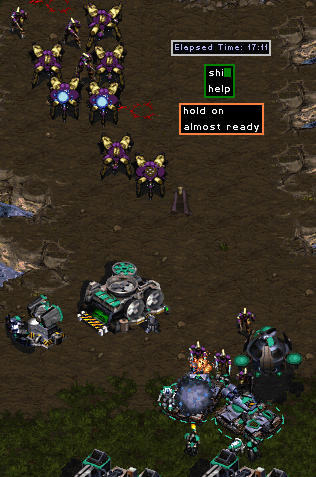
"And lo', there floated,"
"A great yellow blimp!"
"It sent out small fighters,"
"and moved like a gimp."
-Dev
|
| The School of StarCraft | | | Author: | | | IP: | dp-216-1XXXX | | Date: | 05/30/06 05:05 | | Game Type: | Starcraft | | Labels: | Image Heavy(1), Starcraft(3), Rare game(1), Gorgeous(1), Funny(1), Problem: Spam(1), Strategy Focused(2) | | Report Rating: , # of Ratings: 4, Max: 8, Min: 6
Lifetime Rating for NewbEye: 8.1111 |    |
The School of Starcraft
|
Yes, this is a strategy guide.
Everyone
eventually does one.
It's about time I gave it a shot. Prepare to be schooled.
This guide views best in Moz, and probably works equally well in IE...
It was written for a resolution of 1024 wide, and probably works for
other resolutions too...
The Lines of Communication
One thing I've never seen in a StarCraft strategy guide is discussion
on communication. With the rising popularity of team competitions, a
lack of literature on "chatting tactics" leaves many gamers in the dark
about the most efficient way to transmit their plans to their allies.
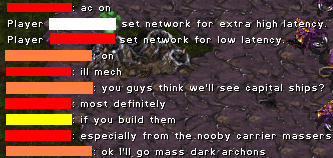
Obviously, communication is very important. At the beginning of the
game, always, always, turn on allied chat. Unless your team is
physically located in the same
room, you and your allies will doubtless be discussing early
game plans by using the only comm option available: the in-game chat.
Spilling your intentions all over the public airwaves is a great way to
provide your enemies ample time to prepare counters.
Some pro players advocate the use of non-allied chat to spread
disinformation. Quite frankly, as beginners in SC, I would not
recommend that you spend time on this complicated strategy. Just ally
your chat so you can concentrate on the game.
Once you've properly secured your comm frequencies, you have to huddle
with your team and decide what you'll all be making. The earlier you
set things in stone, the earlier everyone can start teching to the
units they've promised to provide to the war effort. Wasted seconds at
the beginning of a match can often spell the difference between easy
victory and ignominious defeat.
If, at the game's start, you have no leanings towards one branch of the
tech tree or another, don't be afraid to solicit team members for
opinions. Their goals may require you to produce specific support units
for specific purposes.
It's also beneficial to message as tersely as possible. AOLese,
1337-speak, spamglish
-- call it whatever disparaging name you like -- but the shorthand
reduces the keystrokes you have to initiate in order to get your point
across. For example, instead of typing, "Let's hit the terran at the
bottom middle," you could propose, "go 6?" This reduction in keystrokes
translates directly into time you could use for more important things:
base management, scouting, keeping an eye on the minimap, whatever.
Additionally, it reduces the amount of text your allies have to
interpret. Everyone wins.
So it's clear that the ultimate goal of any typographical shorthand is
to reduce the amount typed. It's easier if your team is a group that
often plays together, and knows each other well. I therefore leave it
up to you, in your individual squads, to develop a language useful to
the situations that typically arise in the games and matchups you play.
And, most importantly, once you've made plans with your teammates, don't
deviate! Good communication isn't happening when
teammates' expectations aren't being met. Nothing is more irritating
than
expecting
goons/tanks/mutas/whatever from your partners and instead getting
zeals/vultures/zerglings to support your own forces. The point bears
reiteration: build what you promise to build, or renegotiate!
Micro and Macro
Even players new to StarCraft can see pathing problems: when moving
out, larger armies tend to string out into line formations. This means
that in any attack, the defending army will always have a slight
formation advantage over the attacking one, with the more-or-less
stationary defenders focussing all their attacks on the leading
invaders. The most unbalanced case, of course, is when one tries to
break a terran siege camp. However, the same applies to low-tech units
as well.
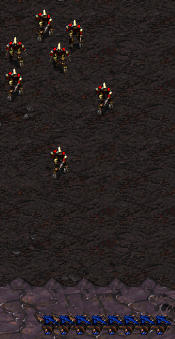
Consider the early zealot vs. zergling matchup, certainly one that pops
up often. Conventional wisdom says that without any micro or upgrades,
when there are five or more zerglings per zealot, the zerglings will
win. Now consider the same example, except the zealots come in
disorganised with units behind each other so they end up getting in the
way, and the zerglings are evenly spread out. The zerglings can
concentrate their attacks on the first attacker, quickly dispatching
it, and then move in unison to engage successive zealots. The
conclusion is clear: a proper defensive posture will allow your troops
to turn back more enemies than otherwise would be possible. So whenever
you have a moment that can be spared, spend it arranging your armies
into ordered formations.
Your neatly-arrayed troops are also a way of
waging psychological warfare against lesser opponents: upon witnessing
your
disciplined micro, the only people who could even contemplate attacking
you would be those who are much more skilled than you.
One important aspect of micro is being able to exert control over each
individual unit in your army, leaving nothing to the vagaries
of SC's algorithms. Though individual control has applications in melee
or ranged combat (goon dancing, focus fire, etc), it is especially
important in the case of casting units. Mainly because, except for the
medic's healing, no spells are automatically cast. "Cloning" is when
one takes a group of spellcasters, and quickly orders each
caster to target a different area or unit, usually by ordering an
entire control group and successively de-selecting a member while
issuing new orders to remaining members. In this way, you can keep your
casters moving in the same general direction while minimising your
fiddling with unit grouping hotkeys.
Having discussed some areas of micromanagement, I would like to go on
record as saying many players focus too much on micro, to the
detriment of their macro
game. As a result, though their units in the field last longer, they
cannot produce reinforcements quickly enough against
opponents who have a good sense of macro. Therefore, I would warn those
of you who mindlessly chase the micro rainbow, ignoring your macro,
which, quite frankly, is equally important.
The blue terran in the next picture is a glowing example of what I mean
when macro is
important. Check out his unit production facilities -- four barracks,
four factories, and four starports. Additionally, the weapon and armour
upgrade facilities are close by. The production
capacity is staggering, especially considering the awesome firepower
that four factories could output while pumping tanks. Blue's
centralised
industrial quarter is also highly efficient -- a few seconds in one
area of the map, and he can train many control groups of units and
upgrade their equipment, and then bring his full attention to bear on
battle micromanagement.
Those of you who are more astute will have noticed that the terran
commander also has lots of supply room. That's another thing that I've
noticed many players just can't do properly. While busy microing, they
run out of supply, and can't create more units. This is truly
dangerous in team games, where an enemy's partners can counter while
your
army is out in the field. So make sure to build lots of supply in
advance.
In my years of StarCrafting, I've come across many, many players who
just mass one single unit and attack-move their armies across the map.
Aside from being boring and taking no skill, this tactic is a gamble.
Veterans of the game know that every unit in the game can be countered.
Massing one single unit is therefore putting all your eggs in one
basket -- if your enemies are on the ball, they can just produce units
to counter your army, and then roll over you. The lesson, then, is to
mix up your forces. Strength in diversity. Make sure your army is
balanced, and no matter what
your opponents throw at you, you'll have units capable of meeting the
challenge, and you won't have to waste time rebuilding a broken army.
Getting the Priorities Straight
In the first section to this strategy guide, we considered how
efficiency in team communications could improve a team's odds of
winning. In the
second section, we examined how building and unit formations and a
steady climb of the tech tree led to further gains in efficiency. Do
you see a pattern here? I think you do.
Being good at StarCraft boils down to knowing when to do what.
Meaning you don't waste your time doing the wrong thing at the wrong
time, the right thing at the wrong time, or the wrong thing at the
right time. You use your time efficiently. So the question to
ask yourself when you're faced with a command decision is this:
would going through with these orders constitute an efficient use
of my time and resources?
We illustrate this question with several examples.
Ever since Brood War was released, invisible mid-game enemies became a
serious issue for every race. So seriously, put some detection at the
entrance to your
main. There's nothing worse than dying early to DTs or lurkers when a
few simple cannons or turrets at your choke/ramp could render cloaked
opposition useless.
Q: Is building early detection an efficient
use of my time and resources?
A: Compared to dying to rush/cloaked units? My death is not
efficient. Warp them cannons!
As illustrated above, it's even better when you block off your entry so
no one can get in. The opposition will be forced to team up against
your allies, who will consequently be "too busy" fending off superior
numbers to assist you when you're attacked. No team play, I know, it
sucks. It's possible your partners
will be unable to withstand the constant pressure, but if they're not
as skilled as you at fighting outnumbered, hey, that's their problem,
not yours.
While your team is dying, your choke defence will buy you time
to tech to your race's capital units before your enemies can get tanks,
reavers, or mass hydra/ling. With a little planning, you'll be able to
take on the entire enemy team, and pull your allies' undeserving butts
out of
the frying pan.
Q: Is sacrificing early resources for static
defence an efficient use of my early game? What if my allies
die?
A: Yes, everyone needs something to defend their bases.
And if my allies die, the very fact that they died early proves
they were worthless and could not have contributed to a victory.
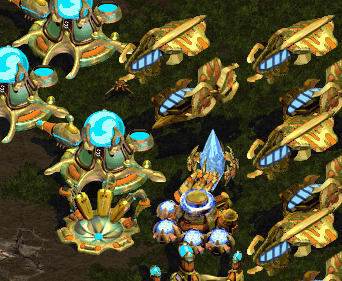
Carriers or bust!
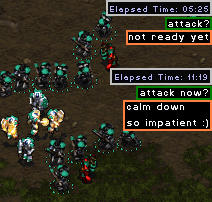
I've watched many replays of students asking me for advice, and I've
noticed that a lot of players have no idea when to attack and when to
sit still. Often, they'll be bullied by their allies into attacking
before they can cobble together a critical mass of units. The result?
They lose
what little military might they had to start with when the other team
drubs the half-hearted attack squad. And the enemy gets an easy time of
countering to boot!
So what can you do when you don't feel ready to take it to the next
level with your partners? Like any good teacher, I can only tell you
not to give in to peer pressure. Don't do anything you're not ready to
do!
Q: Is attacking before I'm ready an efficient
use of my units?
A: What am I, stupid? Sending unprepared soldiers into battle?
Definitely not efficient. I'll attack when the right moment
comes. The right moment always comes.
The Ultimate Strategy
So far, this guide has gone over several broad-based areas where you
can
improve your StarCraft game. I know you've carefully studied my
teachings, and I judge you ready to learn the ultimate strategy. Once
you master this strat, even progamers will fall to your might.
The main thrust of the plan is --
Oops, looks like class is dismissed. Guess it'll have to wait until
next
time. Remember that your battlereports are due at the beginning of the
next lecture. Nubs.
So that's that. As always, thanks for reading, and I hope you reaped
some measure of enjoyment from my work.
Until next time, remember: any fool can teach you how to play StarCraft.
 |
|
|
|
|
|
 Home
Forum
Starcraft Tournaments
Home
Forum
Starcraft Tournaments